
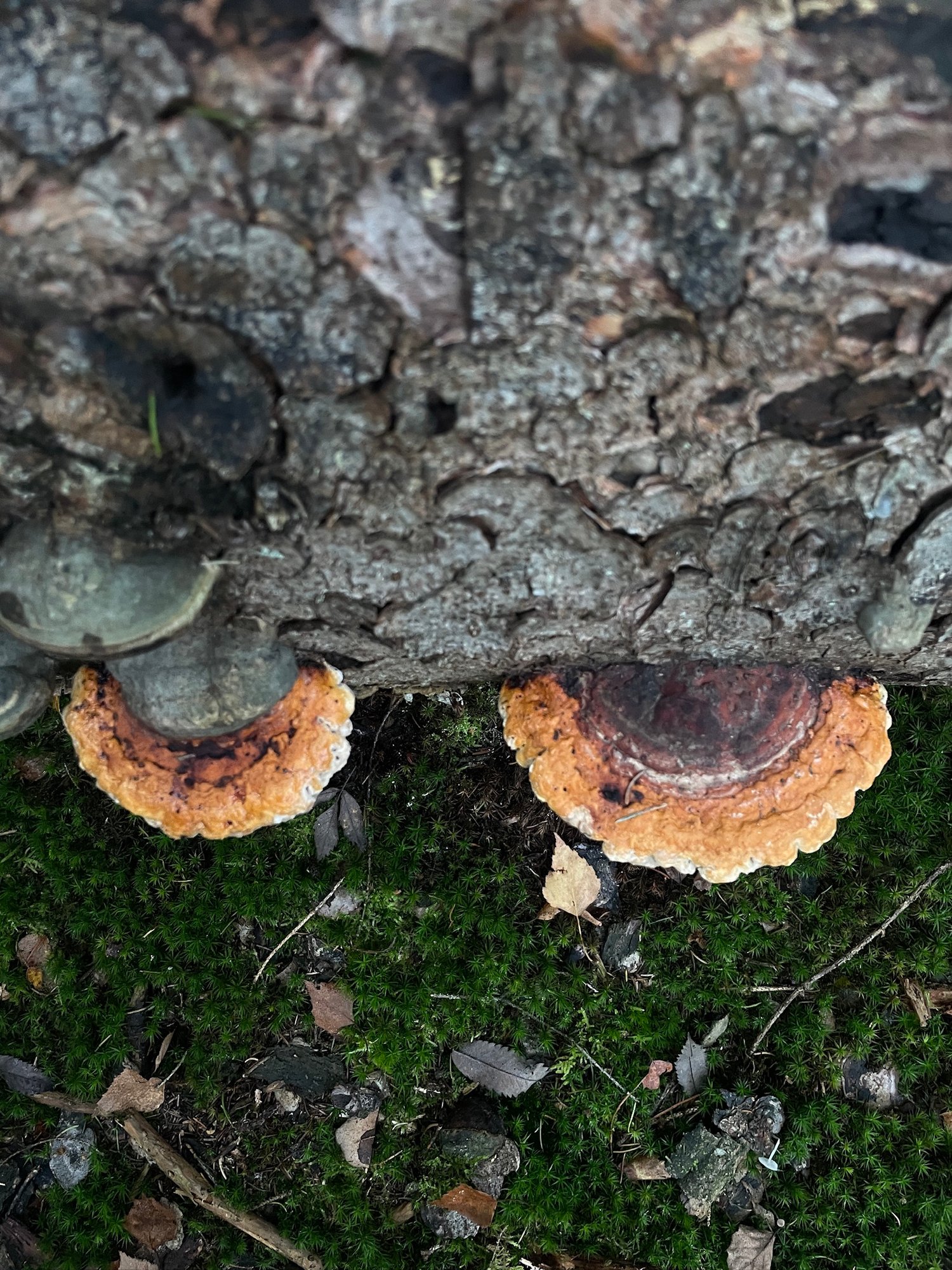
Reishi is a mushroom that grows on old tree stumps and looks like it's been varnished. You can't eat it. People have boiled it into a bitter tea for about two thousand years, and told a lot of stories about it along the way.
A mushroom you can't eat
Forget the white button mushroom in your fridge. Reishi is a shelf fungus. It grows out of dead or dying hardwood, mostly oak here, like a little fan or a kidney. The top is red-brown and shiny, with a white rim where it's still growing. It's hard. Like wood. Try to bite it and you'll lose.
In Dutch it's called the gesteelde lakzwam: the lacquer fungus with a stalk. In China it's lingzhi, the spirit mushroom. In Japan reishi, or mannentake: the ten-thousand-year mushroom. Its Latin name is Ganoderma lucidum. More on that name later, because it's a bit of a scandal.
So if you can't eat it, what do people do with it? They dry it, slice it, and simmer it in water for hours. Or they soak it in alcohol. That's where all the powders, capsules and little brown bottles come from.
A top shelf, an emperor and a snake
1. The Divine Farmer's top shelf. Chinese legend has a man called Shennong, the Divine Farmer, who tasted hundreds of plants on himself to find out which ones healed and which ones killed. The herbal book named after him, written down around the 1st or 2nd century, sorts 365 remedies into three shelves. The bottom shelf is strong and often poisonous. The middle one is for treating the sick. The top shelf is for healthy people: things you could take for years without harm. That's where lingzhi sits. The book even sorts it by colour, with red lingzhi linked to the heart.
2. Emperors and mercury. Chinese emperors wanted to live forever, and they meant it. In 219 BC, Qin Shi Huang sent ships full of young people to find Penglai, an island where the immortals lived among "stone-shaped mushrooms". The ships never came back. Court alchemists brewed immortality elixirs from mercury and cinnabar, and several emperors died from them. Next to that, a bitter mushroom that did nothing dramatic was the safe option. It was also rare: by one old estimate, only two or three in ten thousand old trees ever grew one.
3. The White Snake. The most loved lingzhi story is a love story. A snake spirit called Bai Suzhen takes human form and marries a man named Xu Xian. At a festival he's tricked into giving her a special wine that turns her back into a snake. He sees her, and dies of shock. So she climbs Kunlun Mountain alone to steal the herb that brings back the dead: lingzhi. A guardian blocks her path. Then the old god of long life asks what she's doing. She tells him the truth. He's moved, and he gives it to her. Xu Xian wakes up.
In 2025, scientists named a related species Ganoderma baisuzhenii, after the snake.
Mushroom fans love to spot reishi in every old Chinese pattern, from imperial robes to palace doors. Experts say a lot of that is wishful thinking. Sometimes a swirl is just a swirl.
Why it tastes like tree bark
If you've ever tried reishi tea and thought "this is a log", you're not wrong. The bitterness is the point. It comes from a group of compounds called triterpenes. The other group researchers care about are polysaccharides, long sugar chains, mainly beta-glucans.
And they don't come out the same way:
- Polysaccharides come out in hot water. That's what the old recipe does: simmer the dried slices, covered, for a couple of hours, until the water turns dark brown.
- Triterpenes come out better in alcohol.
That's why you'll see "dual extract" on bottles. It means the maker did both, a water extraction and an alcohol one, and mixed them. Neither is "the right one". It just tells you what's likely in there.
Two thousand years of tea-making found half the method before any lab did.
What the studies found
Science is still catching up with two thousand years of use. The lab work is full of promise. The first human trials show real signals, especially around sleep, tiredness and feeling well. The big, long studies? Not done yet.
- Sleep. 218 adults with chronic insomnia took 980 mg reishi extract or 5 mg melatonin every night for 8 weeks. Both groups slept better, and the reishi group improved more: an insomnia score drop of 8.7 points against 5.6. No serious side effects and clean results. (SLEEP 2026)
- Tiredness. 132 people with chronic exhaustion took a water-based extract or a placebo for 8 weeks. Half of the reishi group improved clearly, against a quarter on placebo. (2005)
- Gentle on the body. 18 healthy adults took 1.44 g a day for 4 weeks. Well tolerated, no signs of harm to liver, kidneys or DNA. (2004)
- Next to cancer treatment. Five small trials used reishi alongside chemo, never instead of it. Four saw a better quality of life. The studies were small, so bigger ones are needed. (Cochrane 2016)
- Heart, blood sugar, cholesterol. Five trials, mostly in people with type 2 diabetes. No clear effect found yet. (Cochrane 2015)
The sleep study is brand new: presented at the SLEEP 2026 conference in June and not yet published in a journal. It compared reishi with melatonin, without a placebo group. Still, it's an exciting first result, and it fits the old habit of drinking reishi in the evening.
Why no final answer yet? Mushroom trials are small and hard to fund, and slow to run. And, as you'll read below, two studies with the same Latin name may not even be testing the same species.
Almost no one has tested what tradition actually describes, a little reishi every day, for months or years. That's the gap science still has to close, and the reason so many people simply try it for themselves.
Came here for focus? That's lion's mane, reishi's morning cousin. Read her story, or meet her as MORNING lion's mane extract.
Before you buy anything
Two bottles on a shelf, one €19, one €34, both say reishi. Turn them around. Four things to look for on the label:
- Which mushroom, exactly. A Latin name, not just "reishi" or "medicinal mushroom complex".
- Fruiting body or mycelium. The fruiting body is the actual mushroom, the shiny thing on the stump. Mycelium is the root-like network, and it's often grown on grain, so part of what you buy can be grain. Do we want grain in a bottle? Not really. We'd rather eat ours as bread.
- How it was extracted. Water, alcohol, or both (dual). Plain ground-up mushroom powder is not an extract, and your body can't do much with it: the cell walls are made of chitin, the same stuff as crab shells (more on chitin).
- How much mushroom went in. Good makers tell you, for example 1 kg of dried mushroom per 1-2 litres of extract. No number usually means a reason not to give one.
And a few good habits:
- On medication? Ask first. Your pharmacist can check it in a minute. Same if you're pregnant or have any other condition.
- Give it time. Reishi is a slow mushroom. Tradition takes it daily, often in the evening, for weeks rather than days.
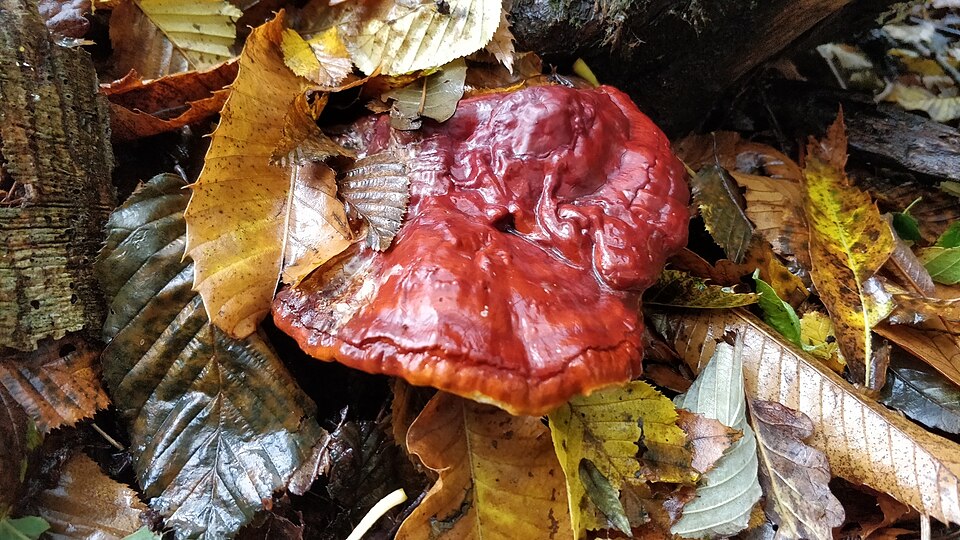
Reishi in the wild, with the shiny, lacquered cap that earned it the name lucidum. Photo: William Bungay, CC0, via Wikimedia Commons.
Want to see one in the wild?
You can, here in the Low Countries. Look at the base of old oak stumps and other hardwood, in late summer and autumn. You're looking for that shiny, red-brown fan with a white edge, sometimes covered in a fine brown dust. That dust is its spores. Leave it long enough and everything around it turns cocoa-coloured.
First time? Go with a guide from Poepkezwam in Antwerp, or join one of our mushroom walks: get on the newsletter and you'll hear when the next one is. You'll learn ten other mushrooms on the way.
Picking isn't allowed in most forests and reserves, so look, photograph, and leave it.
The name scandal
The most famous mushroom in Chinese medicine has been wearing an English name for over 200 years.
In 1781, the English botanist William Curtis described a shiny polypore from European samples and called it Boletus lucidus. A hundred years later it became Ganoderma lucidum. Then Western scientists looked at the red lingzhi from China, saw something shiny and red-brown, and gave it the same name. Done.
Except it wasn't the same. DNA showed the Asian mushroom is a different species. In 2012 it got its own name: Ganoderma lingzhi.
So the shiny fan on a Belgian or Dutch oak stump is the "real" lucidum, Curtis's mushroom. The lingzhi from the old Chinese books, and from most of the studies above, is probably its Asian cousin. Same family. Different mushroom. And thousands of papers still use one name for both, which is why researchers say the science is hard to compare.
Tip: that's also why point 1 on your label checklist matters.
Slow medicine
Reishi isn't the strong medicine. It's the top-shelf one: bitter, gentle, taken for a long time. The emperors wanted something that worked tonight, and they took mercury. The mushroom was the option that asked for patience instead.
Maybe that's what the ten thousand years in mannentake means. Not that it makes you live forever. Just that it doesn't hurry.
Want to try it?
Do it the old way: simmer a few dried slices for an hour or two and drink it slowly. Or take the short cut: a few pipettes of a good dual extract in warm water or tea, in the evening. It's bitter. That's how you know it's reishi.
Ours is called NIGHT. Reishi fruiting bodies grown in Antwerp, dried, fermented, then extracted in alcohol and in litres and litres of hot water, and reduced to a small, dark amount. Hold it against the checklist above. That's what it's there for.
NIGHT – Reishi Extract, 30 or 50 ml.
Sources
History and folklore
- Shennong Bencaojing — date, three classes, 365 entries
- Lingzhi (mushroom) — six colours, Bencao Gangmu, names, rarity, CO₂ and antler forms, Curtis 1781 and Karsten 1881
- Bai Suzhen and Xianhe Tongzi — the White Snake legend, Kunlun, G. baisuzhenii
- Dianna Smith, Ling Zhi, the Chinese Mushroom of Immortality, North American Mycological Association — Penglai, elixirs, overstated iconography
- Claire Voon, Hunting for the Magic Mushrooms of Ancient East Asian Art, Hyperallergic, 2017 — sacred mountains, deer, Queen Mother of the West, Shennong with basket
- Blue jade lingzhi-shaped ruyi, 18th c., Tokyo National Museum
Taxonomy
- Papp, Dima & Wasser, What is Ganoderma lucidum in the molecular era?, Int J Med Mushrooms, 2017
Research (via PubMed)
- Wachtel-Galor, Tomlinson & Benzie, Ganoderma lucidum (Lingzhi): biomarker responses in a controlled human supplementation study, Br J Nutr, 2004
- Tang et al., A randomized, double-blind and placebo-controlled study of a G. lucidum polysaccharide extract in neurasthenia, J Med Food, 2005
- Klupp et al., Ganoderma lucidum mushroom for the treatment of cardiovascular risk factors, Cochrane, 2015
- Jin et al., Ganoderma lucidum (Reishi mushroom) for cancer treatment, Cochrane, 2016
- Xie C., Comparing reishi mushroom versus melatonin for chronic insomnia, SLEEP 2026 abstract, reported by Patient Care Online, June 2026
Food supplement. Do not exceed the recommended daily dose. Not a substitute for a varied diet and a healthy lifestyle. Keep out of reach of children. On medication, pregnant or breastfeeding? Ask your doctor or pharmacist first.