
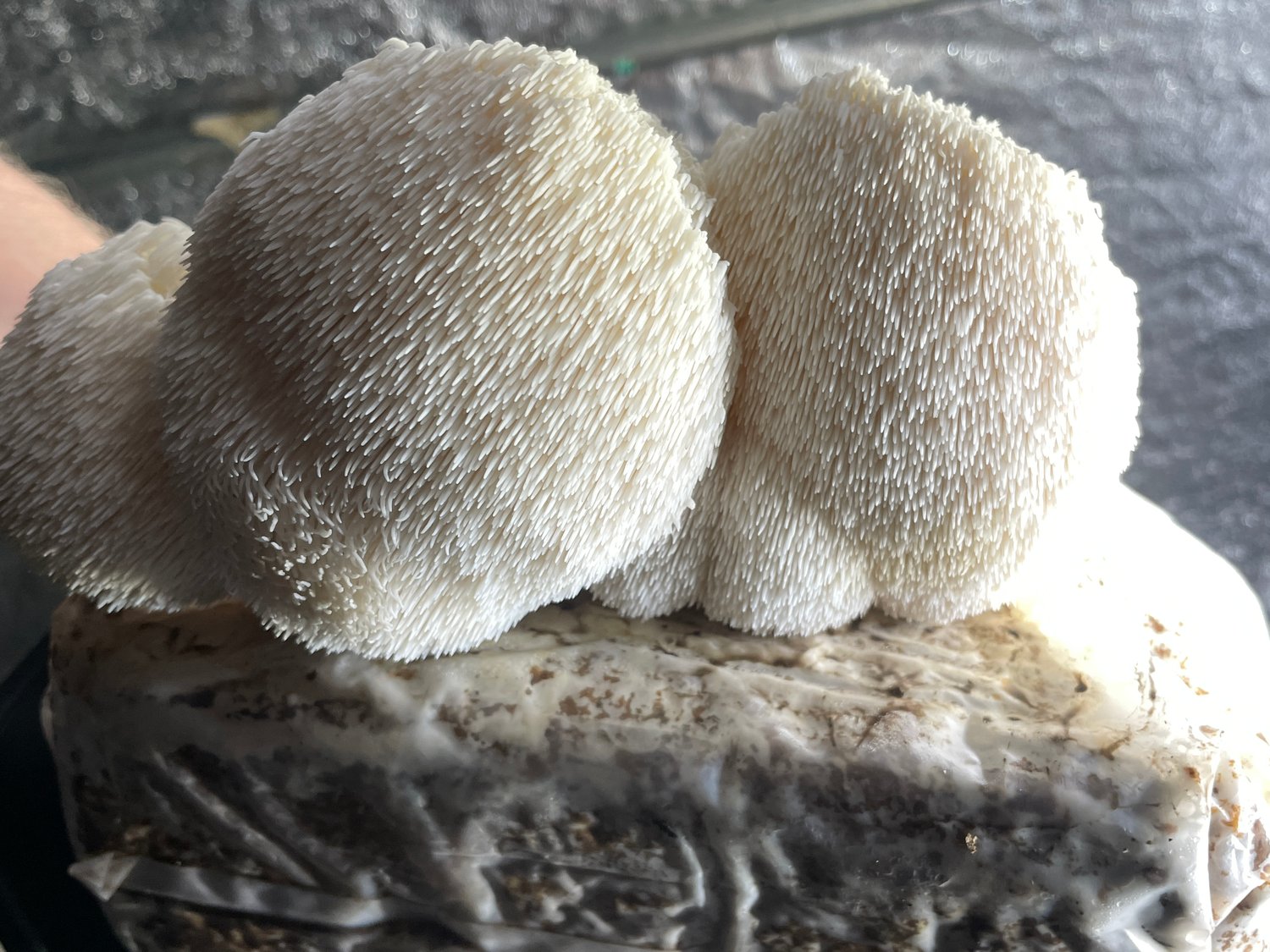
Who is she?
Lion's mane looks like a frozen waterfall, or a pale pom-pom stuck to the side of a dead beech tree. It’s one of the very few medicinal mushrooms you can actually fry in butter and eat for dinner, but you probably clicked here because a reel told you it’s "nature’s focus pill" and you’re wondering if it will finally help you close sixteen of your open browser tabs.
A mushroom with teeth
Forget the white button mushroom sweating in plastic wrap at the supermarket. Lion’s mane (Hericium erinaceus) is a tooth fungus. Instead of a cap and stem, it drops long, white, icicle-like spines downward.
In Dutch, it’s the pruikzwam: the wig mushroom. In Japan, yamabushitake, named after the yamabushi, Japan's mountain monks. In Latin, erinaceus means hedgehog.
If you aren't frying it fresh with garlic and butter, you’ll find it in little brown dropper bottles. And no, you can't just chew a raw mushroom and expect your brain to get anything out of it.
Monks, soup and a rare find
1. The mountain monks.
The yamabushi were ascetic monks who wandered the high mountains of Japan, practising endurance and meditation. Their robes carried round, fluffy pom-poms, and this white, shaggy mushroom looked just like them. So it got their name: yamabushitake, the mountain-monk mushroom. Not a caffeine spike, but something that belonged to people who could sit still for hours.
2. The scholar's soup.
Traditional Chinese texts list the monkey head mushroom (Houtougu) as a tonic for the stomach and digestion. Ancient herbalists believed that when the gut was calm, the spirit stopped racing. Modern researchers call this the gut-brain axis, which sounds high-tech until you realise ancient doctors noticed it simply by watching people eat soup.
3. The accidental find.
Because lion’s mane loves old, decaying hardwood, mostly old beech here in the Low Countries, it was never abundant. In the Netherlands it's on the Red List as threatened, and in 2016 it was named Mushroom of the Year (Vroege Vogels). Finding a clean, snow-white specimen twenty feet up a tree trunk was rare luck.
How to break through the cell wall
If you've ever bought cheap mushroom powder because an ad told you to, you probably noticed it tasted like dry dust and did precisely nothing. That’s because mushrooms build their cell walls out of chitin, the same tough stuff found in crab shells and insect exoskeletons. Human stomachs don't have the tools to break that down raw.
That’s why extracts exist:
- Hot water pulls out the polysaccharides (long sugar chains like beta-glucans) that researchers study for the immune system and the gut.
- Alcohol pulls out the smaller, fat-soluble compounds unique to lion's mane: hericenones (found in the fruiting body) and erinacines (found in the mycelium).
That’s why a real bottle says "dual extract." It means the maker soaked it in both, so you're getting the whole mushroom instead of an expensive jar of processed lawn clippings.
What the lab and the trials say
Neuroscientists like lion’s mane mostly for those two compounds: hericenones and erinacines. In lab settings, they stimulate the production of Nerve Growth Factor (NGF), a protein that helps brain cells grow and maintain their connections.
In people, so far:
- Focus and speed. A 2023 double-blind pilot study gave 41 healthy young adults lion’s mane or a placebo. After a single dose, the lion’s mane group was quicker on a concentration task within 60 minutes. After 28 days, they tended to feel less stressed (Nutrients, 2023).
- Mild memory support. In a classic 2009 Japanese trial, older adults with mild cognitive decline took 3 grams of powder daily for 16 weeks. Their test scores went up while taking it. The catch? Four weeks after they stopped, the scores drifted back down. The effect lasted as long as the habit did (Phytotherapy Research, 2009).
- Quiet nervousness. In a small 4-week trial, 30 women ate cookies with lion’s mane or placebo cookies. The lion’s mane group felt less down afterwards, and tended to feel less irritable and anxious than the placebo group (Biomedical Research, 2010).
Is it a magic fix for ADHD or a substitute for medication? Absolutely not. It won't override a chaotic day or clear a messy desk by itself. Think of it as a slow daily habit, not a stimulant.
Reading the label
Two bottles on a shelf: one €15, one €45. Both say "lion's mane." Turn them around.
- Exact name: Look for Hericium erinaceus, not just a vague "nootropic mushroom blend."
- Fruiting body vs. mycelium: The fruiting body is the actual mushroom on the tree. Mycelium is the root network, often grown on cheap grain (like rice or oats) and ground up together. If you wanted to eat oats, you'd buy a bag of porridge. Look for 100% fruiting body.
- Extraction method: Water, alcohol, or dual. Raw powder is useless against your chitin walls.
- Concentration ratio: Look for numbers like 1:1 1:2 1:10 etc. If a maker won't tell you how many kilos of mushroom went into the bottle, assume they have a reason to hide it.
And a quick safety note: If you're on medication, pregnant, or nursing, ask your pharmacist before adding any new supplement to your routine. It takes two minutes and saves you a headache.
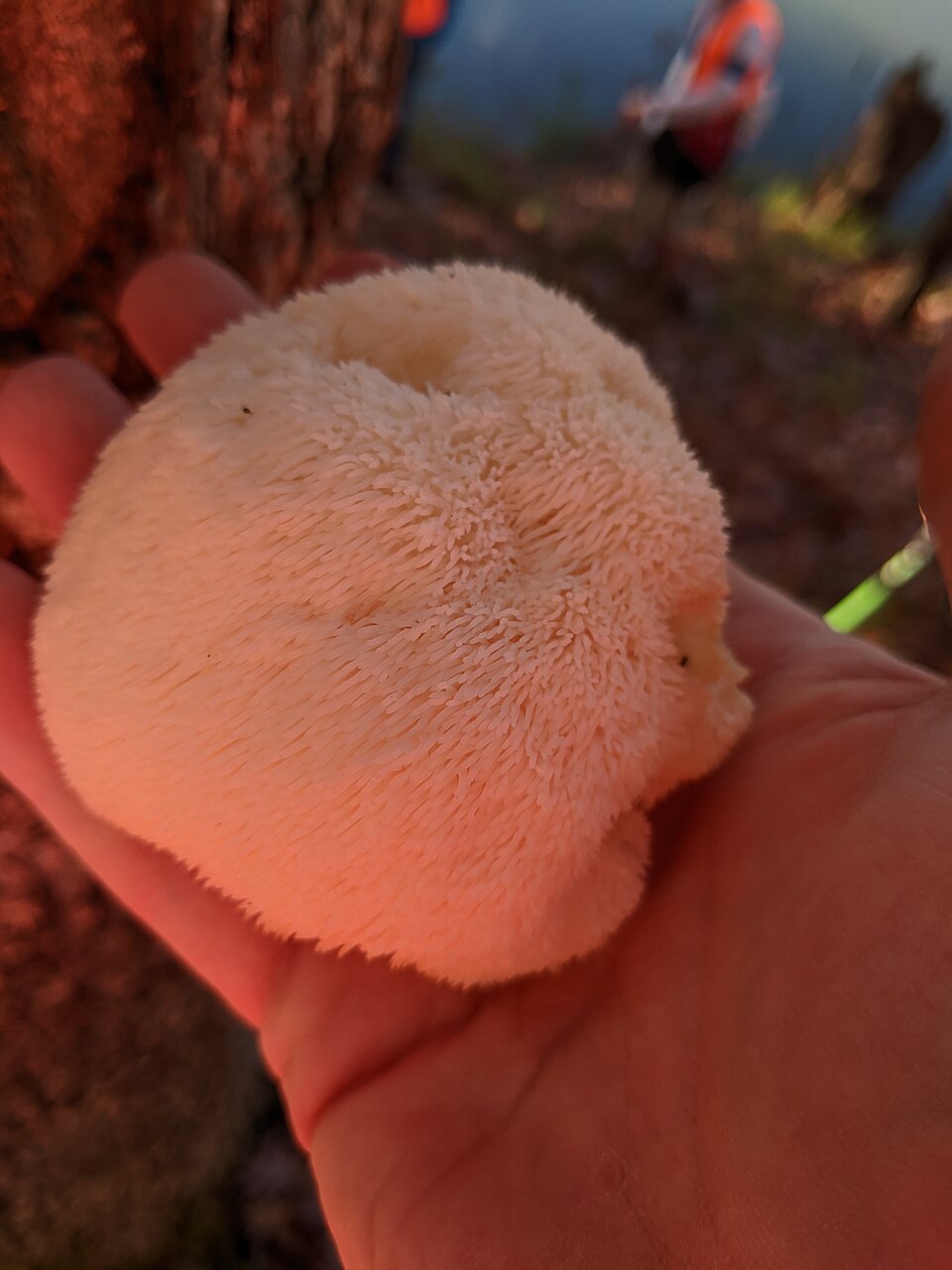
Lion's mane in the wild: white, shaggy, all soft spines. Photo: Hamilton Turner, CC0, via Wikimedia Commons.
Finding one in the forest
You can spot them right here in Dutch and Belgian forests in late autumn, if you look long enough: they’re rare. Look for old, wounded beech. You're looking for a cascading, icicle-like white mass that looks almost too soft to be growing out of dead wood.
Leave it where it stands. Wild lion’s mane is scarce and on the Red List, so a photo is worth more than a harvest. Want to see one up close? Ours grow at the Poepkezwam lab in Antwerp.
If you want to learn how to forage safely without accidentally poisoning yourself, join a local mycology group walk instead of trusting an internet app.
Try it
Lion's mane isn't a quick fix for a Tuesday afternoon panic. It’s an ongoing, quiet ritual.
If you want to try it out, treat it like one. Stir a few pipettes of a proper dual extract into your morning tea or water. Something like MORNING by Ratèl, grown right here in Antwerp, dual-extracted with actual patience, and bottled without the wellness-industry hype words.
Give it a few weeks, close fifteen of those tabs, and let the mushroom do what it's meant to do.
MORNING – Lion's Mane Extract, 30 or 50 ml.
More: how we make MORNING · how to read a lion's mane study · reishi, her evening cousin
Food supplement. Do not exceed the recommended daily dose. Not a substitute for a varied diet and a healthy lifestyle. Keep out of reach of children.
Sources
- Docherty et al., The acute and chronic effects of lion's mane supplementation on cognitive function, stress and mood in young adults, Nutrients, 2023
- Mori et al., Improving effects of Yamabushitake on mild cognitive impairment, Phytotherapy Research, 2009
- Nagano et al., Reduction of depression and anxiety by 4 weeks Hericium erinaceus intake, Biomedical Research, 2010
- Hericium erinaceus, Wikipedia: names, habitat, compounds
- Pruikzwam, paddenstoel van het jaar 2016, Vroege Vogels