
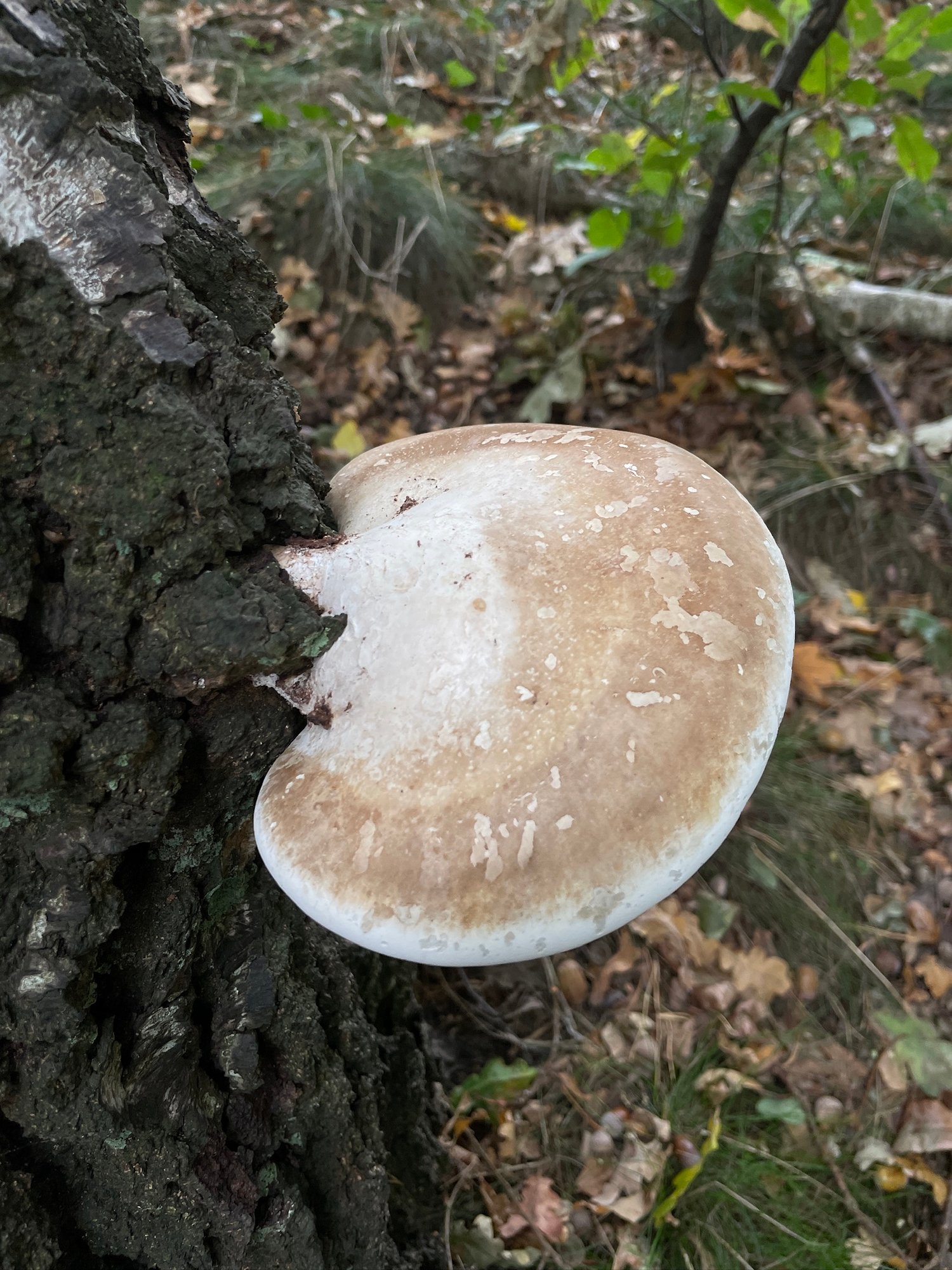
Birch polypore
looks like a pale, leathery desk cushion growing out of a dying birch tree. You cannot eat it, it tastes like cork soaked in tonic water, and no influencer on TikTok will ever tell you it gives you a glowing tan or unlocks 100% of your brain power.
Which is exactly why it’s interesting.
A hoof on a birch
Forget the soft, pretty mushrooms that spring up overnight and melt in a pan. Birch polypore (Fomitopsis betulina, previously Piptoporus betulinus) is a bracket fungus. It attaches itself to dying or dead birch trees like a thick, rubbery hoof, starting smooth and pale cream before turning a dusty grey-brown.
In Dutch, it’s the berkenzwam. In English, it’s also known as the razor strop fungus because 19th-century barbers used strips of its leathery skin to hone their straight razors.
It only grows on birch trees. If you see something that looks like it growing on an oak or a pine, you’re looking at a completely different fungus.
And no, you can't fry it. Try to bite a mature one and your jaw will give up before the mushroom does.
An iceman, a barber and a woodcutter
1. Ötzi’s belt pouch.
In 1991, two hikers found a mummified man frozen in an Alpine glacier on the border between Austria and Italy. He had been dead for 5,300 years. Threaded on a leather strip, he carried two pieces of birch polypore.
When scientists examined Ötzi’s gut, they found eggs of whipworm, a parasite that causes severe stomach cramps. In 1998 the Italian palaeopathologist Luigi Capasso suggested in The Lancet that the fungus was his medicine against them: birch polypore contains compounds with antibacterial and laxative effects. Archaeologists still argue about it. Either way, the Copper Age Iceman walked into the mountains with a fungus on a string.
2. The barbershop strop.
Before disposable blades existed, keeping a razor sharp was a daily ritual. Barbers would peel the outer pore layer off fresh birch polypore, dry it flat, and glue it to a wooden paddle. Its fine, firm, slightly springy flesh gave the steel its final polish.
3. The field plaster.
Woodcutters in Northern and Eastern Europe didn't carry first-aid boxes into the forest. If a hatchet slipped, they would slice a thin piece off a fresh berkenzwam, peel away the soft underside, and press it directly onto the cut. As the story goes, it stayed flexible and didn't stick to the wound.
No levitating monks here. Just people who needed things to work.
Why it tastes like cork and tonic
If you’ve ever tried drinking a decoction of birch polypore, you know the taste is aggressive. That severe bitterness comes from a heavy dose of triterpenes (including compounds related to betulin, the stuff that makes birch bark white).
Like reishi and lion’s mane, birch polypore constructs its cell walls out of tough chitin. Putting raw dried powder into a capsule and swallowing it means most of the active molecules pass right through you unabsorbed.
To get to the useful stuff:
- Hot water extraction releases the polysaccharides (beta-glucans) that researchers study for the immune system.
- Alcohol extraction pulls out the bitter triterpenes, steroids, and fat-soluble acids that labs study for antibacterial and anti-inflammatory activity.
If a bottle doesn't specify a dual-extraction process, you're getting half a mushroom’s chemistry at full price.
What the lab says
Lab researchers have a soft spot for Fomitopsis betulina. It's a chemical factory built to get through northern winters.
- Immune system modulation. In lab studies, polysaccharides from birch polypore change how immune cells respond. Not a blind "boost", more of a nudge (review in the International Journal of Medicinal Mushrooms, 2017).
- Antibacterial and gut support. In lab tests, piptamine and other compounds from the fungus show antibacterial activity.
- Tissue protection. Triterpenes from the fruiting body show antioxidant activity in cell studies.
Is it going to replace a prescription antibiotic or cure anything overnight? No. These are lab results, and the human trials still have to come. But science is starting to see why Ötzi may have carried it.
Checking a bottle
Birch polypore extracts are rare in shops. When you do find one, like our RESET, check four things:
- Exact species name: It must say Fomitopsis betulina or Piptoporus betulinus.
- Fruiting body only: Ensure it’s made from 100% wild-harvested fruiting bodies. Mycelium grown on grain never meets a birch tree, and may miss what the fungus builds from living wood.
- Dual extract: Look for hot-water plus alcohol extraction on the label.
- No filler promises: If a brand claims it "detoxifies your liver in 24 hours," walk away.
A quick note on safety: If you take immunosuppressants, have a bleeding disorder, or are pregnant, ask your doctor or pharmacist first before introducing strong botanical bitters.
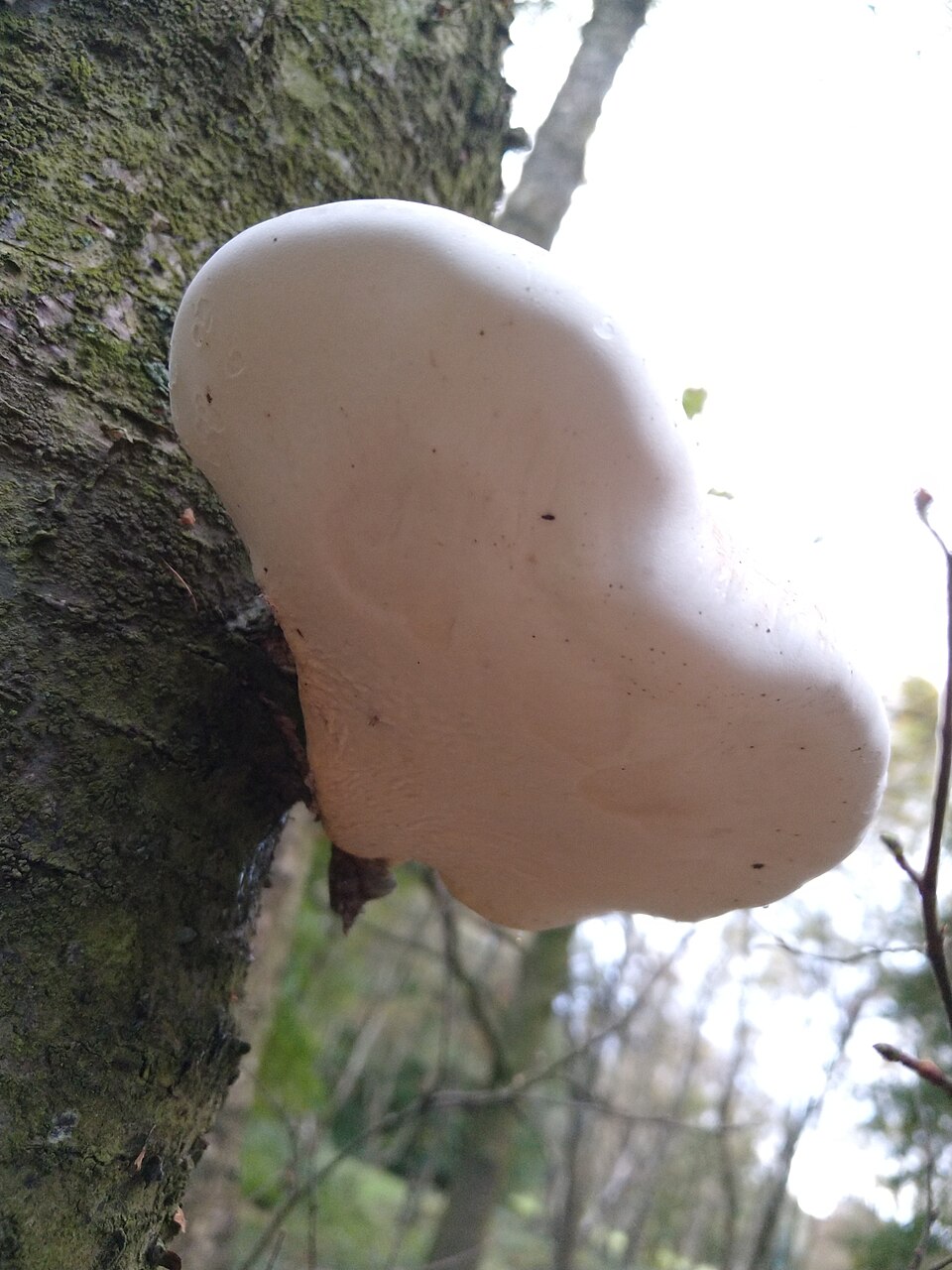
Birch polypore on a birch: a pale, rounded bracket, smooth on top. Photo: Joe Carmichael, CC0, via Wikimedia Commons.
Go and touch one
Good news: this one is easy to find. Take a walk through a damp forest or nature reserve in late autumn or winter and look for dead or decaying birch trees (Betula pendula).
You’ll spot smooth, pale, rubbery discs jutting out horizontally from the white bark. Touch one: it feels remarkably like tough suede.
Feel free to photograph it or marvel at the fact that it looks identical to what Ötzi carried 5,000 years ago. Just leave wild specimens attached unless you’re foraging with an experienced guide on permissioned land.
RESET
Birch polypore isn't for showing off on social media. It tastes bitter, it works quietly, and it asks for patience.
If you want to try it, take a few drops of a proper dual extract, like RESET by Ratèl, in a glass of warm water or herbal tea before bed or during a quiet moment in your day. For the days your head wants a clean slate.
RESET – Birch Polypore Extract, 30 or 50 ml.
Wild-harvested, dual-extracted, small batches.
More: fruiting body or mycelium? · reishi · lion's mane
Food supplement. Do not exceed the recommended daily dose. Not a substitute for a varied diet and a healthy lifestyle. Keep out of reach of children.
Sources & References
- Capasso, L. (1998). 5000 years ago, the Iceman used natural laxatives and antibiotics. The Lancet.
- Pleszczyńska, M., et al. (2017). Fomitopsis betulina (formerly Piptoporus betulinus): the medicinal mushroom with promising properties. International Journal of Medicinal Mushrooms.
- Sułkowska-Ziaja, K., et al. (2012). Chemical constituents and biological activity of birch polypore. Phytochemistry Letters.